
Living Libraries are Fun to Explore By Karen Glenn
Hagerman National Wildlife Refuge, along with other public lands within our park and refuge systems, provides all of us with a living “library” of native plants and animals. The refuge is a great place to study local plants in their natural setting under various growing conditions. The same species of a plant may look very different, depending on the soil type, sunlight received, and companion plants. These protected habitats offer outstanding opportunities to learn more about our local ecology throughout the year across different growing seasons. These public resources provide a safe place for local flora and fauna to flourish, along with supporting the many relationships necessary to maintain a healthy ecosystem. I found out a few weeks ago that Hagerman allows personal foraging while out on the trails, but no plants may be harmed or removed without permission. (It is always a good idea to ask before foraging on public lands.) Restricted areas still provide an opportunity to gain a lot of plant knowledge, since we can always take pictures and make observations. Once a plant or plant family becomes familiar, it is much easier to find it in a location where seeds and other plant materials can be harvested safely and legally. Hagerman is an easily accessible, free, nature library where everyone, expert and novice alike, can hone their naturalist skills. |

Lemon Bee Balm (Monarda citriodora), a member of the mint family, is a common plant found on the refuge. After spending a little time in the field observing plants during different seasons and growing conditions, it becomes much easier to recognize common plant families, like mint (Lamiaceae), with its square stems, and sunflower (Asteraceae), with its compound flowers. Just like in humans, each family is unique and shares certain characteristics, like the number of flower petals and their arrangements, number of stamens, types of fruits, leaf shapes and arrangements, etc. With a little practice and some knowledge of familial characteristics, most observers can get close enough on apps, like iNaturalist to obtain useful information about an unknown plant. Several of my initial ID’s (and I will admit, mostly guesses) have been corrected by other users, who help identify species they have expertise in. There are usually several pictures to compare a plant with. Just like any skill, plant knowledge will slowly build over time. The best strategy is to start with one plant and spend time walking around observing the small details. Once a plant is identified, and you become more familiar with it, you will begin to see it everywhere, even though you probably walked by it for years without a sideward glance! This is the power of focusing on little details and observing things close up. |


A lone sunflower peaks out over the riparian vegetation. You could spend all day in this patch and not see all the different plants growing here. Most naturalist apps allow users to build a plant inventory for specific locations or projects, with dated pictures and the ability to generate reports and documentation. Apps make it quick and easy to search through observations and confirm a plant while out in the field. Popular phone apps are a great way to keep track of what you have in your local habitat, while learning to recognize and identify the native plants on and around your own property. The more plants you observe, the better your identification skills become. It is a process, like anything else. The more you practice, the better you get!
Quite a few “new” plants have appeared on Sticker Hill this past year. In the beginning I was a bit intimidated to begin trying to ID everything on the property. Seeing all the different trees, forbs, and grasses, it seemed like an impossible task, but with modern tools, like iNaturalist, it has been relatively easy to correctly identify most of the native plants here. Finding the family and genus is usually simple, with good pictures of a flower and the entire plant. Species can be a bit tricky, though. It is much easier to use an app, like iNaturalist, instead of dichotomous keys, which requires training and learning an extensive vocabulary of terms. There have been quite a few new plant ID apps developed using AI, but I prefer having a large group of human experts to help confirm the identity of a plant. |


|
|


The flowers of White Avens (Geum canadensis) resemble the center of a rose and tend to fork off of zig zag stems in pairs. This year I finally identified an interesting, shade-loving plant, White Avens (Geum canadensis) growing along the edges of the wood thickets and under the tree canopies. It has been here for a while, but I just got around to investigating it. White Avens is a perennial in the rose family (Rosaceae), and some consider it an invasive weed. I prefer the term aggressive for native plants, and aggressive plants can be very useful to help push out undesirable and invasive plants. Mine is currently displacing the poison ivy under the tree canopies, so it can invade all it wants to here! White Avens is excellent for pollinators and makes a great evergreen groundcover in shady areas where plants are difficult to grow, plus it has pretty white flowers. This plant begins as a rosette on the ground. I tried to ID it early in the year, but the rosette alone was not enough to trigger a good ID suggestion. White Avens (Geum candensis) forms rosettes of leaves under trees and shrubs, resulting in a low-growing ground cover over winter. At this stage the plant is difficult to ID.
|

|
In the Spring, flowers form in pairs on taller stems. The upper leaves are very different from the lower ones. The fruits of White Avens are little spiked balls, which can sometimes get lodged in animal fur and clothing. You might want to consider this if you have long-haired pets that may go frolicking through the patch! Other than that, I really like this plant. I came across quite a few references mentioning the roots of this plant being used medicinally, but that is a subject for another day. I did find a few references of the roots of this plant tasting like chocolate, after roasting. I had to try this, so I harvested a single plant, dried the roots, cut them up, and roasted them to a rich brown color. The brewed tea was deep brown and tasted quite good, but I would not call it a “chocolate” flavor. The plant I harvested looked like a first-year root, so I plan to try again with an older root next time. The first-year roots are tiny and fibrous. In the second-year perennial plants often put down a tap root, which may have more flavor. If nothing else, this plant is attractive and makes a great groundcover for shady areas. Have you ever seen White Avens on the refuge?
|


More Amazing Nature Photos taken at the refuge. Facebook account Required. |
|
Upcoming Activities:
The Friends of Hagerman is Hosting 4 Family Friendly Events in August! Donate to help fund programs like these! |
|
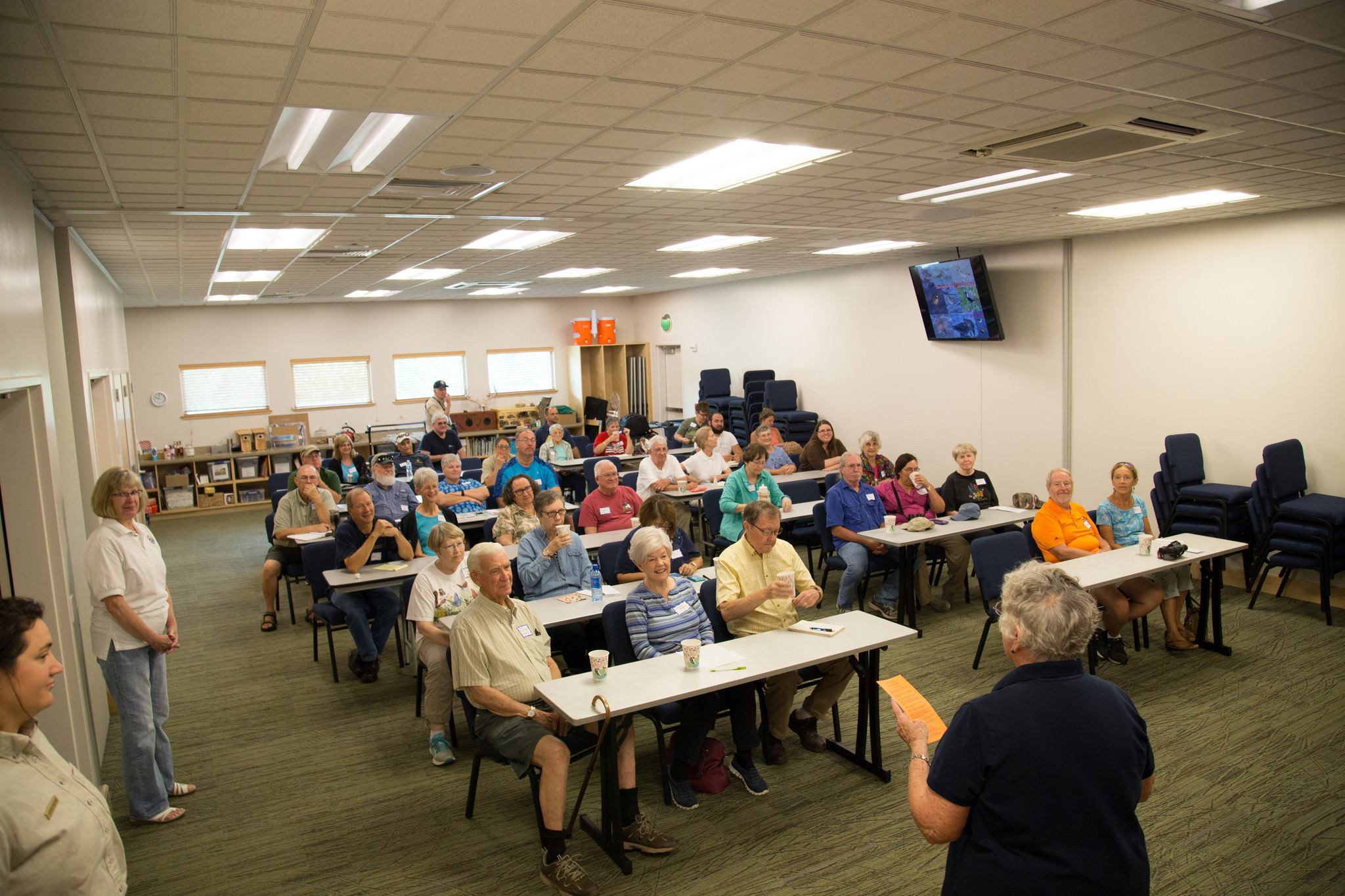
Second Saturday: Birds Are Amazing Flying Dinosaurs with Dr. Thomas Stidham Saturday, August 8th at 10:00 AM in the Visitor Center  Dr. Thomas Stidham will talk about some of the different lines of evidence from anatomy, behavior, and the fossil record that demonstrates that birds are very diverse living dinosaurs. Note: This is a repeat of the Bird Festival presentation on May 16, 2026. 
Dr. Thomas Stidham is an evolutionary biologist and paleontologist who is fascinated by bird biology and evolution from their dinosaurian origins to today. During his career as a professor at Texas A&M University, the Chinese Academy of Sciences, and now Austin College, he has published scientific research on birds from the Arctic to the Antarctic. In addition to his main work on birds, Tom’s broad natural history perspective also has resulted in research publications on insects, mammals, reptiles, plants, and much more, including the discovery of new species in Texas and elsewhere. As a professor at Austin College, Dr. Stidham engages an active student body in exciting biology courses, mentors students in independent research projects in his lab, and continues his scientific collaborations around the globe. Registration is not necessary—all are welcome! But if any of these programs spark your curiosity, signing up will get you a friendly reminder three days beforehand. You’ll also receive our once-a-month Featherless Flyer newsletter—no email overload, and it’s easy to unsubscribe anytime. Register for the August 8 Presentation Future Second Saturday Programs |
|
Save the Date! Our Refuge Roundup Festival will be Saturday, October 10, 2026!
|
The Trails are Looking Good!
Photo by Brian Crain A heartfelt thank-you to the volunteers who care for Hagerman's trails! Even in the summer heat, they're a joy to explore in the early morning, when Painted and Indigo Buntings are especially abundant. |

ADOPT-A-GOOSE 2026
Help Feed the Geese Over-Wintering on Hagerman National Wildlife Refuge Each winter, thousands of Snow Geese and Ross’s Geese visit Hagerman National Wildlife Refuge (HNWR). These geese have migrated thousands of miles from nesting grounds near the Arctic Circle to HNWR. To provide a vital food resource for these exhausted and hungry travelers, HNWR plants fields of winter wheat. The Friends of Hagerman National Wildlife Refuge (FoH) sponsors the “Adopt-a- Goose” fund raiser to help offset budget constraints of the refuge and purchase the wheat seed needed to plant the fields. Please consider supporting our effort with your generous donation. How can you help? Adopt-a-Goose Donations of any amount are greatly appreciated.
Why did the Friends of Hagerman start Adopt-A-Goose?
What are the benefits?
What is being provided by the Friends of Hagerman?
Donation Method You can donate with a credit/debit card by scanning the QR code or using the link friendsofhagerman.org/Donate. The Friends of Hagerman NWR Foundation is a nonprofit 501(c)(3) entity whose mission is to instill reverence, respect and conservation of our wild creatures and habitats through supporting environmental education, recreational activities and programs of Hagerman National Wildlife Refuge and the U.S. Fish and Wildlife Service. No goods and services are to be received by donors; therefore, all donations may be tax-deductible. |

Butterfly Garden Walks
Registration is not necessary |

Pipevine Swallowtail (right) by Laurie Sheppard |
New Hats in the Nature Nook! We are thrilled to present our collection of Eco-Hats for July. These hats are known for their variety of embroidered animals, reptiles, and birds. Feel free to browse through the Nature Nook for a wonderful selection. Don't forget to check out our straw hats that are also available. Remember: Next weekend is Tax-Free Weekend! No Tax on Hats and Shirts!! |
| Congratulations to Isa Smith-Willhouse for successfully completing the Eighty Species Challenge! Stop by the Visitor Center to pick up your official challenge, and return your completed form for a special pin (below)! The prefect challenge for Scouts and youth groups!
|


The Weekly Bird Census
Left to Right: Wayne Meyer, Nancy Riggs, Jack Chiles, and Mike Petrick Each Tuesday a team of experienced birders, including Master Naturalist Jack Chiles, traverse 35 miles of refuge roads and hiking trails, documenting every bird they encounter. This Bird Census is reported to The Cornell Lab of Ornithology for use in research, and each week we will bring you a link to their actual bird count, and a summary of their adventures.
Black-crowned Night Heron and Wild Turkeys It started out very warm today and just continued to heat up at a fast rate the rest of the census. The volunteers are starting to mow the fields in preparation for disking later on. There were lots of Western Cattle Egrets in the mowed fields. In spite of no mudflats we did get 3 species of shorebirds, Killdeer, Least Sandpipers and Spotted Sandpipers. A flock of Wild Turkeys crossed the road in front of us near the Hagerman Cemetery. Near Meadow Pond we had a nice find of two Black-crowned Night Herons. We saw 3 Pileated Woodpeckers, 2 at the low water crossing on Bennett and a flyby near the first curve coming into the refuge on Refuge Road. We saw a total of 6 Mississippi Kites, a Red-tailed Hawk and 4 Red-shouldered Hawks. We saw a Black-and-white Warbler and a Prothonotary Warbler. We finished the day with 57 species. See the rest of Jack's notes and the latest Bird Census Results |

The Friends of Hagerman NWR Photo Club Meeting September 5, 2026 at 10:00 AM in the Visitor Center
There are a few changes in entering and submitting your photos this year. Will cover how to enter the contest. Also, tips on choosing your best photos and the best category. Understand what the judges look for in choosing the winners. Note new meeting time 10:00 AM on September 5th Event Leader: Nancy Miller, photoclub@friendsofhagerman.org |

Friends of Hagerman NWR Annual Nature Photo Contest The Annual Friends of Hagerman National Wildlife Refuge (HNWR) Nature Photography Contest sponsored by the Friends of Hagerman NWR is open to photographers of all ages and skill levels. Youth are encouraged to enter and compete in the Beginner category. Ribbons and cash prizes are awarded in multiple divisions and categories, with a unique Best in Show for Youth. Judges are asked to consider composition, originality, and visual impact. Winning photographs will be announced at the Second Saturday presentation in November. Overview
Click on Photo Contest Tips for suggestions on how to get an impactful image. Sponsor the Friends with a membership to save on entries fees for the photo contest. View photos and names of the past winners. |
Join Cindy Steele for: The Refuge Rocks! Programs for Children
During this engaging program, participants will discover that soil is a living ecosystem that plays a vital role in nature. Through an age-appropriate mini lesson and hands-on exploration, kids will learn how soil helps grow food, filters water and provides homes for countless tiny creatures right beneath our feet. The program includes:
Blending science, creativity, and outdoor learning, Dig It! helps young learners see the ground beneath them in a whole new way. Space is limited. Advance registration is encouraged. So grab your curiosity and your sense of adventure—it’s time to Dig It! |
 It may look like “just dirt,” but soil is alive with secrets! Young nature explorers are invited to get their hands dirty at Dig It! The AmazingWorld Under Our Feet, a hands-on, sensory-driven environmental science program at Hagerman National Wildlife Refuge. This interactive class will take place Saturday, August 15, 2026, from 10:00–11:30 a.m. and is designed for youth ages 5–10.
| Puddles' Craft Corner By Cindy Steele, Master Naturalist |

Dragonflies!

Welcome back to Puddles’ Craft Corner!
You've heard of dragonflies and maybe even seen one or two, but what are they exactly? Are they mythical dragons? No! Are they flies? No! So…what are dragonflies? If you’ve ever been around water in the summer, then there’s a pretty good chance that you’ve seen a dragonfly. These bugs can be big or small, and almost any color you can think of like red, pink, gold, or even purple! Even though they can be lots of different colors, they can have lots of things in common, even if they look very different from one another. For example, dragonflies aren’t really dragons at all! They are super strong and super-fast, but they won’t hurt you. Even though their long bodies look like a stinger, dragonflies don’t sting. Dragonflies are insects just like bees, ants, and ladybugs.
What Are Dragonflies?
Dragonflies are flying insects. They got their name because they look like small, winged dragons, with big eyes and monstrous jaws. They have long thin bodies and two pairs of wings. Their bodies can be many different colors. Dragonflies have two pairs of see-through wings, huge eyes, and long bodies. Dragonflies live near lakes, streams, and ponds throughout most of the world. There are about 2,500 species, or types, of dragonflies. Dragonflies are ancient insects. Some types of dragonflies have been around for a very long time. Do you want to know how long? They’ve been flying around our Earth for over 300 million years. But they were much larger at that time. It’s estimated that one extinct species called the Meganeura Monyi had a 30-inch wingspan! The largest dragonfly in the world today lives in Australia and the scientific name is Petalura Ingentissima, but it is called the Giant Petaltail. It’s wingspan is a little over 6 inches!
What Do Dragonflies Look Like?
Dragonflies have three main parts, the head, the thorax, and the abdomen. The head includes the eyes, mouth, and antennae. Dragonflies use their two huge compound eyes and antennae to locate prey. These ferocious aerobatic hunters are renowned for their enormous compound eyes, which give them the optical precision necessary to seize prey in mid-air over open water. When they catch their prey, they use the sharp...
Junior Ranger Program: Advanced and Intermediate
|
| The Junior Ranger Pledge As a Junior Ranger I watch out for danger I protect nature I have fun I share what I've learned with everyone! |

|
Sponsors Enable the Friends to…
Join Today! Memberships available for $20 |
Photo by Cathy Van Bebber | Sunrise at the Little Sit by Laurie Sheppard |
Meet Jack and the Bird Census Team and learn how to identify the birds of North Texas while enjoying the beautiful sunrise over Lake Texoma! Modeled after Cornell's national "Big Sit" event, a group of dedicated birders invite you to join them at sunrise to conduct a bird count as multiple species fly to the water and the surrounding land to feed. Leaders will bring spotting scopes and will provide tips for identification of the many species you will see.
Participants are advised to bring a chair, binoculars and water. The First Saturday of every month, beginning 30 minutes before sunrise. Location: H Pad, Sadler, Texas 76264 (H Pad is in Sadler, but it is part of the refuge) GPS Coordinates: 33.734961, -96.780582
|
|
Do You Like to Work Outside? The Refuge Needs You!
|

It takes a lot of people to have a beautiful garden! The Wednesday Garden Team Love to work with native plants and meet other gardeners? Come and help us add plants, weed and mulch our beautiful butterfly garden. Garden Team volunteers get first dibs on thinned native plants as well as access to seeds and cuttings for propagation. Gardeners meet on most Wednesdays, but times vary. Contact Us to subscribe to the volunteer garden team weekly email. Provide own tools and gloves. Minimum age 18, or 16 if accompanied by parent/volunteer. |
Mowing and Refuge Beautification: The Work Crew Do you enjoy working outside, mowing, sprucing up hiking trails, trimming and removing brush and general cleanup? Show your love for nature by joining the Outdoor Crew at Hagerman National Wildlife Refuge. Outdoor Crew volunteers meet on the First Tuesday and Fourth Saturday of every month. Contact Us for exact times, dates and other details about joining the volunteer Work Crew. Scouts welcome! |
Visitor Center Volunteers Needed! |
Do you enjoy meeting all kinds of people from all over the world, and like-minded people in our area? If yes, consider joining our team of Visitor Center Volunteers. You will greet refuge guests, distribute maps and other refuge information, and make sales in the gift shop. Shifts available every day of the week: Monday through Saturday 9 AM to 12:30 PM and 12:30 to 4:00 PM, Sunday 1:00 to 5:00 PM. Training is provided. Contact Us if interested. |
|
| Thank You To Our Contributors: Jack Chiles, Karen Glenn, Nelda Zamir, Cindy Steele Refuge Manager: Kathy Whaley Deputy Refuge Manager: Mary Istre Visitor Services Manager: Spencer Beard Friends of Hagerman NWR Foundation 6465 Refuge Road, Sherman, TX 75092 Phone: 903-786-2826 Join us on Facebook: |

Search for any word--do not use quotes for phrases |
6465 Refuge Road Sherman, TX 75092
|



Kroger: Stop by the customer service desk at Kroger and link your Kroger Card to the Friends of Hagerman: the Friends will get rewards for every dollar you spend, at no cost to you.
Please add info@friendsofhagerman.org to your contacts to ensure delivery of registration confirmations, account information and the Featherless Flyer
See you at the refuge!